


Cautious with money, moderate with risk
April 2026 – The profile of the Macedonian user of banking services is characterized by rationality, caution and an orientation towards financial stability.
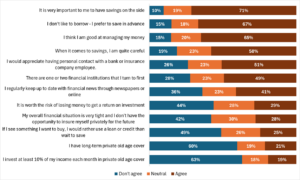
Macedonian citizens have a cautious and frugal approach to personal finances, with a strong orientation towards security and a moderate willingness to take risks. As part of its regular research, Indago researches citizens’ habits and attitudes towards finances, which in turn directly influence their behavior and financial decision-making. The results show that Macedonian citizens have a predominantly cautious and rational approach to managing personal finances, with a strong orientation towards security and savings. For a large part of citizens, it is important to have savings (71%), with the majority expressing a clear preference for saving over borrowing (67%). In addition, a significant part of citizens (65%) consider themselves cautious when making financial decisions and show a responsible attitude towards managing their finances. In terms of financial behavior, citizens show a pragmatic approach: 25% of them are willing to use credit or a loan for larger expenses rather than waiting to save, which indicates a certain openness to borrowing, although 49% disagree with this, which confirms that the orientation towards savings predominates.
Use of banking products
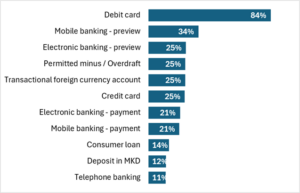
Banks play a significant role in the functioning of the financial system, enabling citizens to make their financial decisions. In this context, it is important to monitor the extent to which citizens use banking services and products. According to the results of the survey conducted, 99% of people over the age of 15 use bank services, which indicates a high level of use of banking services. Payment cards remain the most used banking product among users. Debit cards are used by 84% of users, while credit cards are used by 25%. In addition, 25% of users have an active overdraft on their account. At the same time, the development of information and communication technologies significantly stimulates the digitalization of banking services. More users use digital channels to manage their finances, with 34% using mobile banking and 25% using electronic banking.
Satisfaction with banks
Banking customers express a high level of satisfaction with the branch they visit most often. The average satisfaction score is 4.20 on a scale of 1 to 5, where 1 indicates “not at all satisfied” and 5 “very satisfied”. As many as 87% of customers express satisfaction, while only 3% are dissatisfied, indicating a generally positive perception of service in branches.
Sources of information about banking products and services
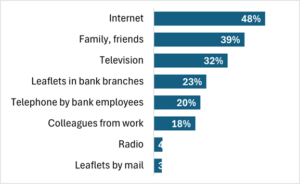
The majority of users are informed about banking products and services via the internet (48%), which indicates the significant role of digital channels. Family and friends (39%), as well as television (32%) are also important sources of information. A smaller proportion of users receive information through leaflets in bank branches (23%), phone calls from bank employees (20%) and work colleagues (18%). Traditional media have a smaller impact, with radio (4%), leaflets sent by mail (3%) and daily newspapers (1%) being the least frequently used sources of information.
About the Survey
The Financial Services Survey was conducted as part of Indago’s omnibus survey conducted in the period September – October, 2025 on a representative sample of 1010 respondents aged 15+.